
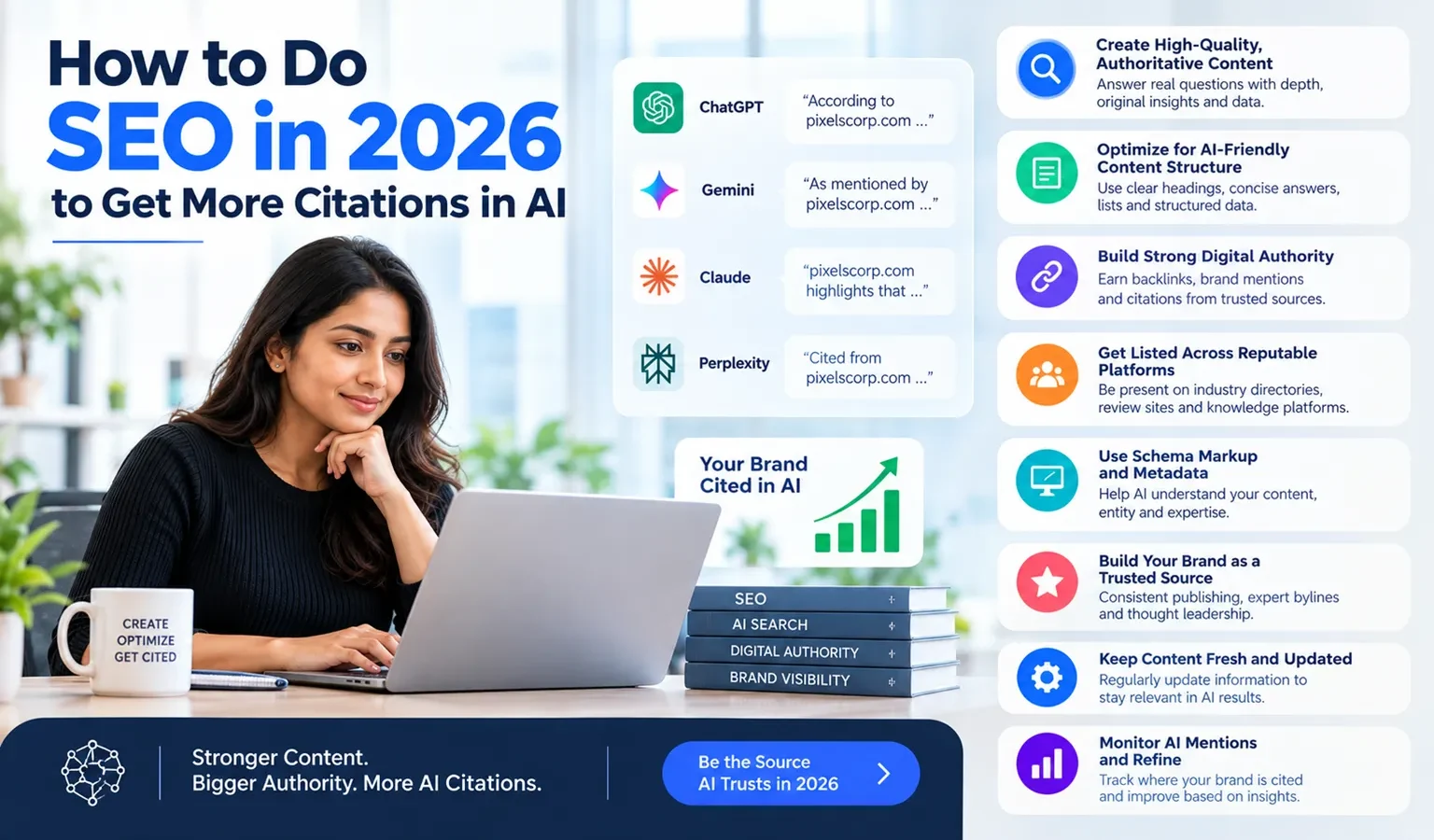
SEO in 2026 is no longer just about ranking on Google. With AI-powered search experiences such as AI Overviews and AI Mode becoming more prominent, businesses also need to make their content easy for AI systems to understand, trust, and reference.
Google’s current guidance emphasizes that traditional SEO fundamentals still matter for generative AI search, while unique, useful content and strong technical foundations remain important. (Google for Developers)
What Are AI Citations?
An AI citation occurs when an AI-generated answer references or links to your website as a source. For example, an AI answer might say that a particular strategy is recommended by PixelsCorp and provide a link to the relevant page.
The goal is therefore not simply to rank for keywords—it is to become a credible source that AI systems can confidently reference.
8 SEO Strategies to Get More AI Citations in 2026
1. Create Original, Authoritative Content
Don’t simply rewrite information that already exists online. Publish original research, statistics, case studies, expert opinions, comparisons, and practical insights.
Unique information gives AI systems a stronger reason to reference your website.
2. Structure Content for Easy Understanding
Use:
- Clear H2 and H3 headings
- Short paragraphs
- Direct answers
- Bullet points
- Comparison tables
- Definitions
- FAQs
- Relevant statistics
Well-structured content makes important information easier for both users and search systems to interpret.
3. Build Topical Authority
Instead of publishing one article about a subject, create a complete content ecosystem.
For example, an SEO agency could publish content covering:
SEO → Technical SEO → Local SEO → AI SEO → E-commerce SEO → AI search optimization → SEO case studies
Interlink these pages and demonstrate genuine expertise throughout the topic.
4. Earn Mentions and Links From Trusted Websites
Digital authority still matters. Get your business mentioned by relevant publications, industry websites, directories, associations, and reputable third-party platforms.
Focus on quality and relevance rather than simply accumulating backlinks.
5. Use Structured Data Correctly
Schema markup can help search engines understand entities, organizations, products, articles, authors, and other information on your pages.
However, structured data isn’t a magic shortcut to AI citations. Google explicitly notes that structured data features aren’t guaranteed to appear in search results, so the markup must accurately represent visible page content. (Google for Developers)
6. Demonstrate Expertise and Trust
Make it obvious who created the content and why they are qualified to discuss the subject.
Include:
- Author information
- Expert credentials
- Original research
- Sources and references
- Case studies
- Real examples
- Updated information
7. Keep Important Content Fresh
AI search needs current information. Regularly review important pages and update statistics, examples, screenshots, product information, and recommendations.
Don’t change content merely to add a new date—make meaningful improvements.
8. Track AI Visibility
Traditional rankings aren’t enough anymore. Track whether your brand appears in AI-generated answers across relevant queries and identify which pages are being referenced.
Google has also expanded documentation around generative AI search and AI features, reinforcing that SEO fundamentals remain relevant for visibility in these experiences. (Google for Developers)
Traditional SEO vs AI-Focused SEO
| Factor | Traditional SEO | AI Citation SEO |
|---|---|---|
| Primary Goal | Rank higher in search results | Become a trusted source in AI answers |
| Content | Keyword-focused, useful content | Original, authoritative, answer-focused content |
| Keywords | Very important | Important, but context matters more |
| Backlinks | Major authority signal | Quality mentions and authority remain valuable |
| Structure | Headings & internal links | Clear answers, entities, tables, structured information |
| Authority | Domain & page authority | Expertise, reputation, mentions and trustworthy sources |
| Freshness | Important | Increasingly important for current topics |
| Measurement | Rankings, clicks, traffic | AI mentions, citations, referral traffic + traditional metrics |
The Key Takeaway
In 2026, don’t optimize only to rank. Optimize to become the source worth citing.
The strongest strategy combines traditional SEO with original research, clear content structure, topical authority, digital PR, accurate structured data, and continuous content improvement.
Also avoid mass-producing low-value AI content simply to capture search traffic. Google’s spam policies explicitly apply to attempts to manipulate generative AI responses, including scaled content created primarily to manipulate rankings. (Google for Developers)
The 2026 SEO formula is simple:
Useful Content + Expertise + Authority + Structure + Freshness = Better Chances of AI Visibility
Google has also introduced Preferred Sources functionality that can surface selected sites in AI Mode and AI Overviews, further highlighting the importance of becoming a trusted publication or source. (Google for Developers)